
 By Wayne Elijah
The majority of water damage is not caused by an abnormally powerful storm. It is due to the fact that a house has minor weaknesses such as hairline cracks, worn-out seals or slow drains that were not substantial enough to be repaired but could not resist continuous pressure from rain blown by the wind. These weaknesses were already there; storm season just exposed them.
That knowledge will also change the way you see maintenance. You are not just doing housework; you are sealing those weak spots before they are hit by a storm.
Start with the building envelope
The building envelope is essentially every surface that’s keeping what’s inside from being outside: your walls, your roof, your windows, your doors, and the seams and seals surrounding them. In normal weather, a hairline crack in the stucco or a worn seal on a window doesn’t pose too much of a problem. But during a storm, that minuscule gap is taking a direct hit from fast-moving, high-pressure water. Everything changes. The invisible becomes catastrophic.
So take a stroll around the perimeter of your house and scout for hairline seams between siding panels, tiny gaps between siding and trim, and breaks in the caulking. Check the flashing between your roof and chimney, and where your downspouts penetrate the soffit, for the same reasons. Wind-driven rain behaves like a garden hose aimed at your house, spreading up and laterally in sheets that can overwhelm normal downward shedding. Pinpoint leaks can be hard to notice amongst overall wetness, so use an infrared camera if you have one to see where water may be infiltrating even if you can’t see or feel it.
Two systems that get overlooked
The HVAC condensate line is the last thing you’d ever think to put on your storm-prep checklist, but it absolutely belongs there. It’s extremely humid before and after a storm, and that surge of moisture combines with the regular condensation produced by the air conditioner to create the perfect environment for algae to grow inside the line. If the line gets blocked and the water back flows into the air handler, it will flood the unit and the surrounding part of the attic. This can accurately be described as a preventable indoor flood because it has nothing to do with rain actually entering the structure. A few weeks before peak storm season, pour a mixture of diluted bleach down the line to the outside.
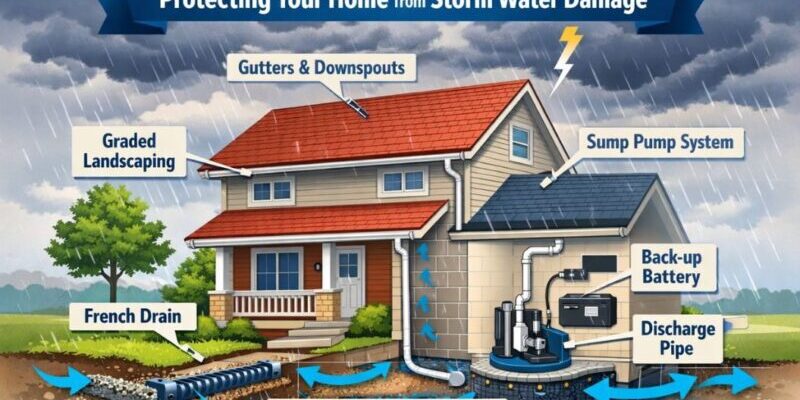
Most people remember to check the sump pump, but not the systems that back it up. The power goes out in a storm. It just does. And it often stays out for a while. A mere sump pump on its own, with no battery backup or secondary pump, is worthless exactly when you need it the most. Make sure the float switch kicks the pump on and off, verify that the battery backup takes and holds a charge, and, while you’re at it, locate that main water shutoff. If the power goes out and the sewer system backflows through the drain, you’re going to need to know where that is.
Homeowners dealing with water damage naples fl face a layer of complexity beyond rainfall alone. Salt-air corrosion accelerates the deterioration of metal flashing, window frames, and sealants at a rate that inland properties don’t experience, which means the inspection cycle needs to be shorter and more thorough.
Drainage isn’t just about gutters
The majority of gutter failures occur due to capacity – i.e., they simply can’t handle the downpour. When downspouts and undersized scuppers can’t swallow the flow fast enough, gutters overflow, dumping hundreds of gallons of water against the foundation during a single rainstorm. Clean them beforehand, but go outside during a rainy day, pop open an umbrella, and see where the overflow’s coming from before casting blame on a system. Often it’s simply old, inadequate equipment.
Underground, French drains and area drains get clogged with subterranean muck over the years. Run a hose through them to ensure optimal drainage before storm season hits. Sprouting roots can be a clue that these lines are obstructed. And don’t forget soil grade: flat or, worse, a grade toward the house that leads surface runoff directly to the foundation, where hydrostatic pressure does its work quietly over time.
Don’t skip the driveway and patio. Impermeable surfaces that have settled toward the structure over the years redirect significant volumes of water. If your driveways are tipped toward your house, you’ll be enjoying your very own reflecting pool. Look for settled areas that slant toward the house and repour – or, better yet, consider permeable pavers for an eco-friendly solution.
The cost of waiting
A mere one inch of water in your property can cost up to $25,000 in structure and content damage, according to the National Flood Insurance Program (NFIP). That estimate doesn’t include the inevitable mold remediation, which becomes necessary within a day or two of the event if dehumidification isn’t already well underway. Mold remediation and rot are secondary damage. That’s our nice way of saying that’s what happens when the problem isn’t addressed fast enough.
Professionals are your best shot. Of course, there are only so many professionals, and after a widespread flooding event, all of them are spoken for. That 24-hour service window stretches to 24 days. Knowing a good, local restoration company before you need one – knowing whom to call and having them know you or at least pick up your call – is just part of what it means to prepare for a storm. The window to actually get maintenance done is always shorter than you think it’s going to be. They never give you enough advance warning that you can just go out and hastily renovate the building all at once.